Stand-up comedy set at home: record it to time your jokes
Record a stand-up comedy set at home in Chrome as a sound-only M4A, then use the transcript's line times to see how long each bit runs and trim the set to your slot.
A stand-up comedy set lives or dies on time. If your open mic gives you five minutes and you run seven, the light goes on in the middle of your best bit. This guide shows you how to record your set at home in Google Chrome as a sound file, then read the transcript's line times to see exactly how long each bit runs, so you can trim the set before you ever get on stage.
You record sound only. There is no camera to set up and nothing to tidy behind you, and each run lands in a folder on your own computer.
Why time a stand-up comedy set at home
Most comics know their set is "about five minutes". Fewer know that the second bit takes two of them. Saying a set in your head is faster than saying it out loud, and saying it out loud alone is faster than saying it to a room that laughs. A recording settles the argument.
Timing it at home gives you three things:
- The real length of the whole set, not the length you hope it is.
- The length of each bit, so you know which one to cut when you need 30 seconds back.
- A record of how the set changed, run by run, so you can hear whether a rewrite helped.
Cheap Recorder runs in Chrome and saves every recording to a folder you pick. When you switch off Record my webcam and do not pick a screen, it saves an M4A audio file instead of a video. The Free plan needs no card and gives you 12 hours of recording a month on 1 device at once, which is a lot of five-minute sets.
Set up the room and the microphone
You do not need a quiet studio, but you do want to hear yourself clearly. Close the window, turn off fans, and stand where you would stand on stage: comics deliver differently sitting down. A wired or USB microphone a hand's width from your mouth is best. A laptop's own microphone works if you stay close to it.
Skip a Bluetooth headset as your microphone. The recorder shows Bluetooth microphone selected as a warning, and on a Mac a Bluetooth headset used as a microphone switches to a low-quality mode that sounds like an old phone line.
Then open the recorder in Chrome:
- Switch off Record my webcam and leave the screen unpicked.
- Tick the microphone you will use.
- Press Choose folder... and pick a folder such as
Comedy. The recorder does not remember the folder between visits, so you choose it again each time. - Under Options, decide on Record the microphone untouched. It turns off the echo, noise and volume correction. Tick it with a good microphone in a quiet room, because a set swings from asides to shouted punchlines. Leave it unticked on a laptop microphone or in a noisy room.
- Leave Live transcript ticked and choose the language you perform in. There are 25. The transcript is your stopwatch.
Test for 30 seconds before the first run
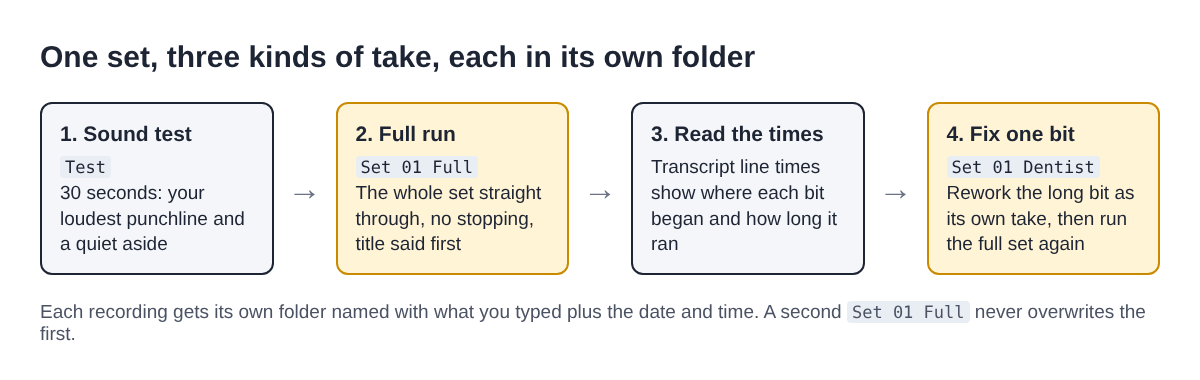
It is much quicker to find a sound problem in a thirty-second test than at the end of a full set. Name the test Test, press Start recording, and do your loudest punchline and your quietest aside. Watch the level bar for your microphone: it should move with your voice. If it stays still, the wrong microphone is ticked or its own mute is on.
Play it back. If the punchline crackles, step back. If the aside disappears, step closer. The no sound guide explains each microphone message if something is wrong.
Record the full set as one named take
Type a name in Name this recording before you start. Left empty, every run is called Recording, and five of those are hard to tell apart. Use the set and what kind of run it is: Set 01 Full. Each recording gets its own folder named with what you typed and the date and time it began, so a second Set 01 Full next week sits beside the first and never overwrites it. Sorting the folders by name keeps every run of the set together, oldest first. Names are cut at 60 characters, and characters a file name cannot hold, such as a question mark, are left out.
Three habits make the timing honest:
- Do the whole set without stopping. If you fluff a line, keep going the way you would on stage. Stopping hides how long the set really runs.
- Leave a beat where the laugh goes. An empty room gives you no laughs, so a set timed with no pauses comes out short. Count one or two seconds after each punchline you expect to land. If speech recognition stops listening during that silence, the recorder starts it again for as long as you are still recording.
- Start with the first words of your set, not "okay, here goes". The transcript's first line should be your opener.
Worked example: a five-minute set with one long bit
With the live transcript on, the recording's folder holds a plain-text file with the time of each line. Open it in any text editor. Find the first words of each bit, write down the time on that line, and work out how far into the recording each bit began. The gap to the next bit is that bit's length.
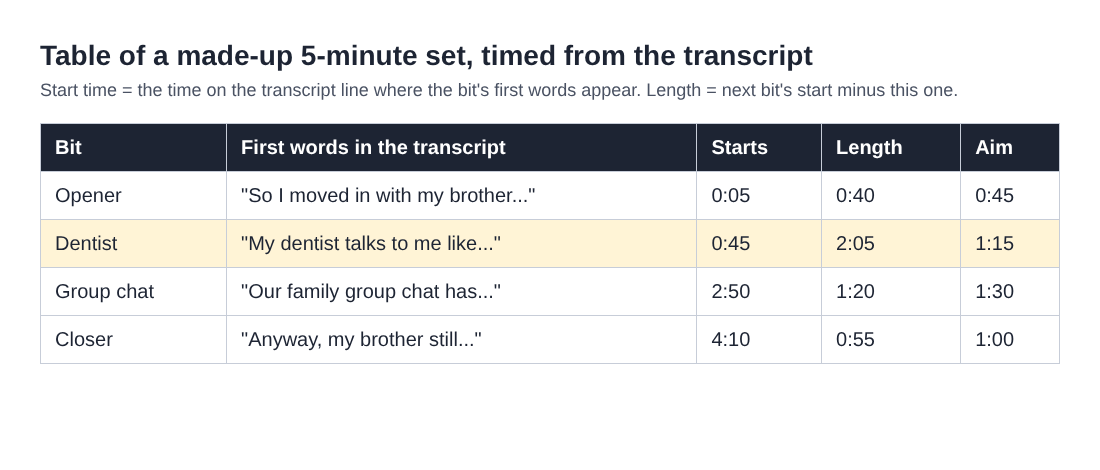
Say your open mic gives you five minutes, and this is your first full run:
- The opener starts at 0:05 and the dentist bit at 0:45, so the opener ran 40 seconds. Close to the 45 you planned.
- The dentist bit runs from 0:45 to 2:50: 2 minutes 5 seconds against the 1 minute 15 you aimed for.
- The group chat bit and the closer both come in close to plan.
- The set ends at about 5:05. Over your slot, and almost all the extra time is in one bit.
Now read the dentist lines in the transcript. You will often see the problem in writing that you missed out loud: a setup said twice, a tag that repeats the punchline, a story that wanders before the turn. Cut it on paper, then record just that bit as Set 01 Dentist until it lands near 1:15. Finally, run the whole set again as Set 01 Full. Two full runs and a few short takes cost under 20 minutes of the Free plan's 12 hours.
Do not expect the transcript to spell your jokes right. Speech recognition writes what it hears, and it will mishear names, slang and the word you stretch for effect. You only need it to catch the first words of each bit and the time beside them. For pacing inside a bit, listen to the file, as you would for the stanzas in a poetry reading at home.
Keep new material on your own computer
Your recordings stay in the folder you chose, on your computer. The guide to where recordings are saved shows what lands in each folder. Two things do leave it, and you should know both:
- While the live transcript is on, Chrome sends your microphone audio to Google to turn it into text. If a bit is brand new and you do not want that, untick Live transcript and time that run with a stopwatch instead. The live transcript guide explains how it works.
- The activity log keeps the folder and file names you chose. Name runs by set and bit, like
Set 01 Dentist, not by the punchline.
When you want to send a run to a writing partner, the card's download button follows the recording's format, so it reads Download M4A and hands over the original with no upload. M4A is AAC at 192 kbps and plays on most phones. Download MP3 and Convert send the file to the server, which deletes it as soon as that finishes; the convert guide lists every format, including WAV for an audio editor.
Frequently asked questions
Should I record with friends in the room?
If you can, yes, because real laughs change your timing. Tell them you are recording before you start, and expect the transcript to pick up some of their reactions as stray lines.
How long a pause should I leave for a laugh?
Only you can judge that for your material. One or two seconds after a punchline you expect to land keeps a home run closer to a stage run than no pause at all.
Can I time the set without the transcript?
Yes. Untick Live transcript and use the file's own length for the whole set, with a stopwatch or a note of when each bit starts as you play it back.
Do I need video to rehearse stand-up?
Not for timing. Sound only keeps the files small and the setup quick. If you want to check your stance and hands, record a webcam run separately.
Get started
Pick your set, stand where you would stand on stage, and record a 30-second test tonight. Create a free account, no card needed, and your first run saves to a folder on your own computer.
Screen recording that is cheap and easy.
Visit cheaprecorder.com↗